We bring taste of India to you.
We provide exquisite home made food for small gatherings or large parties as per your need.
~:~:~:~:~:~:~:~:~
Recipes of delicious food.
Visit 'Main course', 'Desserts' and other section of this site for recipes.
If you have skills in cooking and want to share your creation with the world, please
Contact us.
~:~:~:~:~:~:~:~:~
The cuisine of India is characterized by its sophisticated and subtle use of
many spices and vegetables. Indian food is as diverse as many ethnic and
cultural groups in India. Just like Indian culture, food in India has also been
influenced by various civilizations, which have contributed their share in its
overall development and the present form. Tradition, ethnicity, geographic
location, religion or individual preference defines a typical meal.
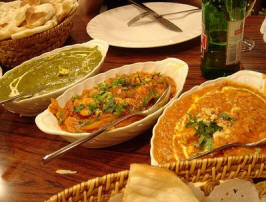
~:~ Curries with Naan ~:~
The colonial period introduced European cooking styles to India adding to
the flexibility and diversity of Indian cuisine. Indian cuisine has had a
remarkable influence on cuisines across the world, especially those from
Southeast Asia. In particular, curry, which originated in India, is used to
flavor food across Asia.
Influence of cultures
As a land that has experienced extensive immigration and intermingling
through many millennia, India's cuisine has benefited from numerous food
influences. The diverse climate in the region, ranging from deep tropical to
alpine, has also helped considerably broaden the set of ingredients readily
available to the many schools of cookery in India. In many cases, food has
become a marker of religious and social identity, with varying taboos and
preferences. For instance, a segment of the Jain population will not consume
any roots or subterranean vegetables. We will discuss different groups and
their food preferences in various articles here.
One strong influence over Indian foods is the longstanding vegetarianism within sections of India's
Hindu, Buddhist and Jain communities. People who follow a strict vegetarian
diet make up 20–42% of the population in India, while less than 30% are
regular meat-eaters
Core Ingredients
The staples of Indian cuisine are rice, atta (whole wheat flour), and a
variety of pulses, the most important of which are masoor (most often red
lentil), chana (bengal gram), toor (pigeon pea or yellow gram), urad (black
gram) and mung (green gram). Pulses may be used whole, dehusked, for example
dhuli moong or dhuli urad, or split. Pulses are used extensively in the form
of dal (split). Some of the pulses like chana and "Mung" are also processed
into flour (besan).
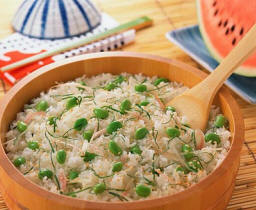
~:~ Veggie Rice Pulao (rice pilaf) ~:~
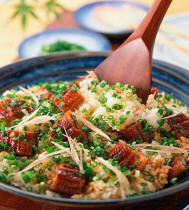
~:~ Soya Rice Pilaf ~:~
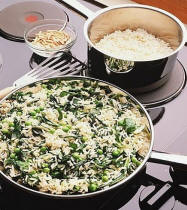
~:~ Rice Pilaf with Fish ~:~
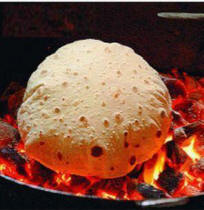
~:~ Roti in Tandoor ~:~
Oil
Most Indian curries are cooked in vegetable oil. In North and West India,
groundnut oil has traditionally been most popular for cooking, while in
Eastern India, Mustard oil is more commonly used. In South India, coconut
oil and Gingelly Oil is common. In recent decades, sunflower oil and soybean
oil have gained popularity all over India. Hydrogenated vegetable oil, known
as Vanaspati ghee, is also a popular cooking medium that replaces Desi ghee,
clarified butter (the milk solids have been removed).
Spices which make Curry
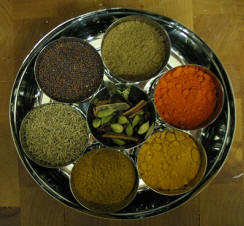
~:~ Typical spices assortment ~:~
The most important/frequently used spices in Indian cuisine are chilli
pepper, black mustard seed (rai), cumin (jeera), turmeric (haldi, manjal),
fenugreek (methi), asafoetida (hing, perungayam), ginger (adrak, inji),
coriander, and garlic (lassan, poondu).
Popular spice mixes is called Garam Masala which is usually a powder of five or more dried spices, including
cardamom, cinnamon, and clove. Each region or I should say each individual
chef, has a distinctive blend of Garam Masala.
Goda Masala is a prevalant spice mix in Maharashtra. Some of the leaves are used in whole or crushed form like tejpat (cassia
leaf), coriander leaf, fenugreek leaf and mint leaf. The use of curry
leaves is typical of all South Indian cuisine. In sweet dishes, cardamom,
nutmeg, saffron, and rose petal essence are used.
What is Curry ??
In India, the term "curry" usually means "gravy". In western countries it is more related to spices in Indian food.